Printed shells
Translucent or matte PETG is selected by heat exposure, finish, light transmission, and scale. Additive striations are treated as controlled material character, not hidden behind false photography.
Materials · Roles before decoration
Printed geometry creates form, diffusers control glare, metal carries load, felt holds the visual field, and approved low-voltage electronics remain accessible.
Translucent or matte PETG is selected by heat exposure, finish, light transmission, and scale. Additive striations are treated as controlled material character, not hidden behind false photography.
Acrylic diffusers and reflective inserts are physically checked for hotspot control, glare, clearance, and service access with the approved core.
Recycled PET felt can provide local absorption and a quiet visual ground. Performance claims require project-specific evidence; the material alone is not a room treatment.
Steel, aluminium, wood composite, inserts, rails, and wall fixings are matched to verified loads and substrates. Site professionals retain responsibility for the building connection.
Only the documented low-voltage LED module, driver, cable, clearances, and ventilation path belong inside an approved design. Fixed wiring remains qualified-electrician work.
Visible finish, module identity, hardware, cable exit, service access, packing orientation, and care notes are checked against the written proof before dispatch.
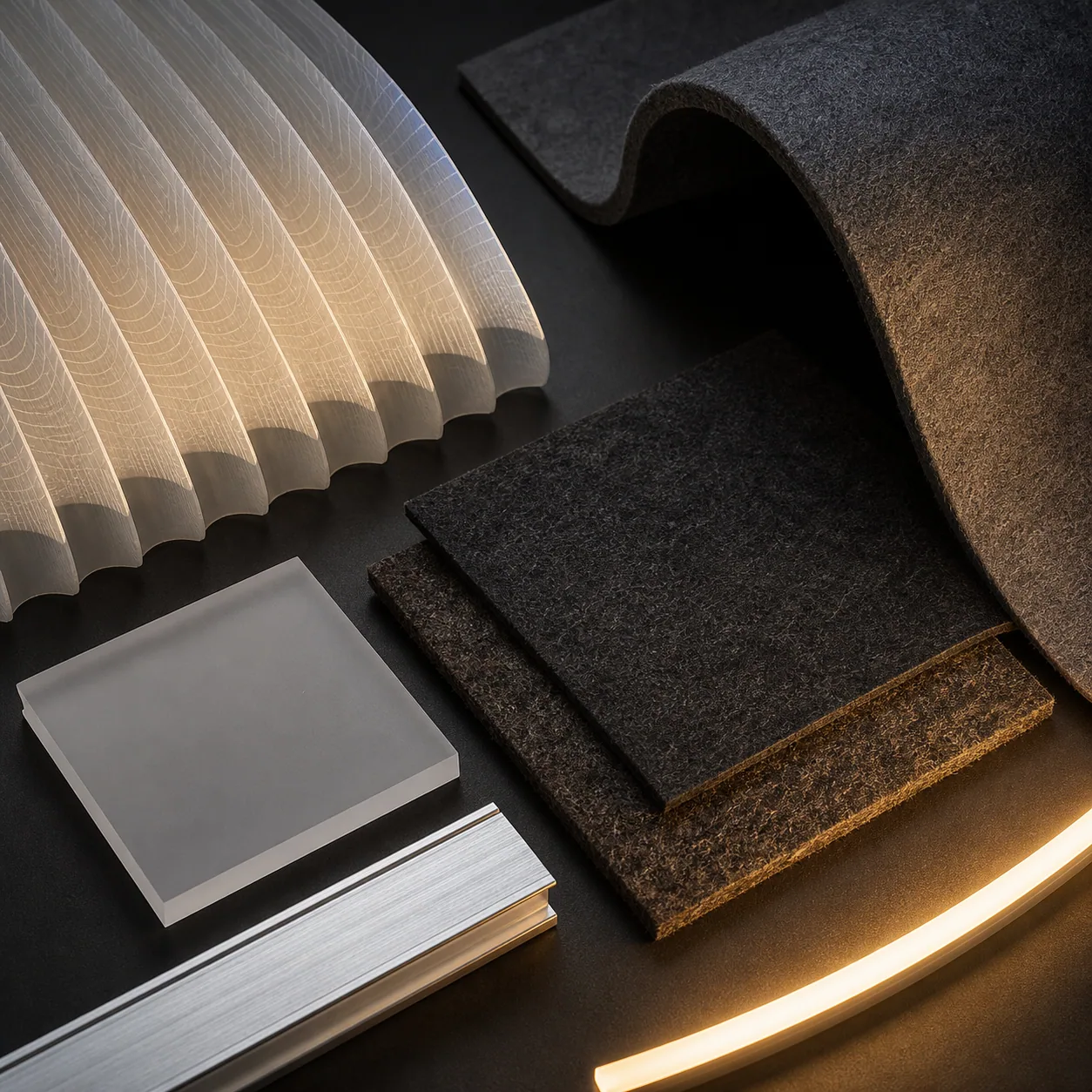
Concept material board
Final grades, colors, suppliers, fire properties, and acoustic data remain provisional until the written project specification is approved.